Selling Your Cornelius NC Lakefront Home? Build the Dock File
July 23, 2026
July 23, 2026
A Cornelius lakefront home can be photograph-ready, staged, and priced with conviction, and still lose ground in the last two weeks of escrow. The house is almost never the reason. The reason is a thin folder of paperwork that describes what a buyer is actually allowed to do with the water in front of it.
Sellers preparing a listing at The Peninsula, Robbins Park, Watermark Lake Norman, Patricks Purchase, or Connor Quay tend to spend their pre-market energy on finishes and landscaping. That energy is well placed. The uncorrected mistake is treating the dock as an amenity rather than as a separately governed asset with its own title trail.
At the Q1 2026 Lake Norman waterfront median of $2,364,000, a dock documentation gap that would be cosmetic on a $500,000 house becomes a five- to six-figure credit at the closing table.
That is the thesis of this piece. Everything below is evidence for it.
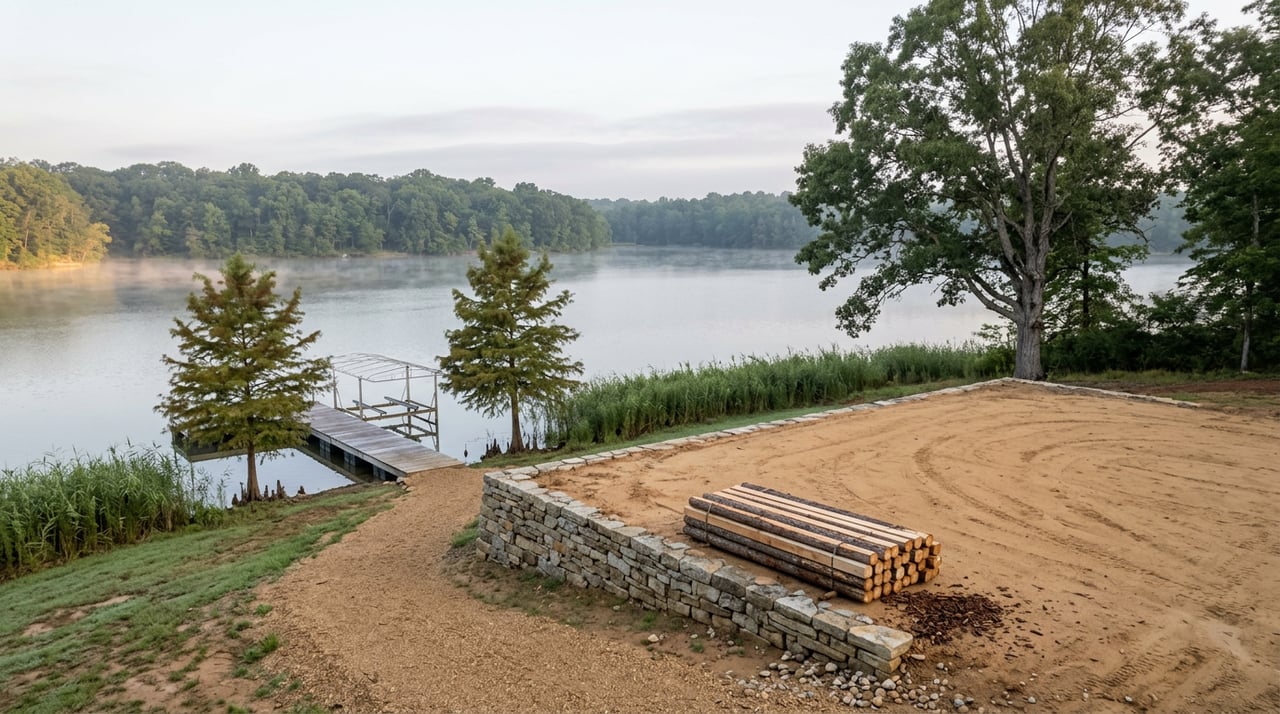
Lake Norman is a hydroelectric reservoir. Duke Energy created it in the 1960s and operates it under a Federal Energy Regulatory Commission license. Under that license, Duke owns the lakebed and an upland buffer, and the practical border of private ownership is the 760-foot full-pond elevation, the water surface when the lake is 100 percent full at 760 feet above sea level.
Everything at or below that line, the pier, the boat lift, any seawall, any riprap, exists on Duke's property under Duke's rules through the Catawba-Wateree Shoreline Management Program. A Cornelius seller who assumes the HOA or the Town of Cornelius has final say is starting the transaction from the wrong premise. Duke Energy controls dock approvals on Lake Norman; the county and the HOA layer on top, they do not override.
The consequence for a listing is direct. Your property boundary on the survey and your property boundary for the piece of infrastructure buyers care most about are two different lines.
A clean pre-listing dock file has ten documents. Assemble them before the first showing, not after inspection.
| Document | Where it comes from | Why buyers ask |
|---|---|---|
| Current Duke lake use permit | Duke Energy Lake Services via LAPS | Confirms the structure is authorized as it stands today |
| Pier tag photo | Physically on the structure | Duke uses the tag to locate permitting history |
| Approved site plan and construction drawings | Copy from prior permit file | Confirms slip dimensions and footprint |
| Boat lift authorization | Duke permit + Mecklenburg County electrical permit | Lifts are separately reviewed and must fit the permitted footprint |
| Seawall or riprap approval | Duke shoreline permit | Stabilization work triggers its own review |
| Shoreline classification for the parcel | Duke Lake Services | Determines whether platforms can be covered or slips added |
| NCDEQ correspondence | If any dredging or wetland impact occurred | Water-quality and buffer work sits outside Duke |
| U.S. Army Corps correspondence | If fill or navigable-waters work occurred | Federal layer for dredge, fill, wetlands |
| HOA dock and shoreline approvals | The community's ARC file | Some Cornelius communities are stricter than Duke |
| Any Duke violation or enforcement letters | Owner records | Silence on this question is not the same as clean history |
The list looks long. In practice, most of it can be pulled by a single call to Duke Lake Services at 800.443.5193 and a request to the community's architectural committee. What matters is that it exists as a bound set before a buyer's agent asks for it.
Duke lake use permits are valid for one year. Lake Services typically inspects structures at expiration and tags them at closeout. That short validity window is the mechanism that creates most of the friction Cornelius sellers experience.
Here is how a standard sequence runs when the file is not ready:
The timeline is the whole point. A buyer paying at or above the $2,364,000 Q1 2026 Lake Norman waterfront median expects turnkey lake living, and dredging or wetland work extends the review window materially past the standard four to twelve weeks. There is no version of a normal closing calendar that absorbs a fresh permit application discovered in week two.
Five years ago a lakefront buyer asked whether the dock conveyed. In 2026 a well-represented buyer asks four sharper questions, and Cornelius listings that cannot answer them cleanly lose the last several percent of price.
The permitted slip dimensions and lift capacity are the first question. A buyer bringing a wake boat has a specific length, beam, and dry weight in mind. The permit either matches that vessel or it does not.
Water depth at the slip is the second question. Cornelius shoreline pricing can swing five hundred thousand dollars or more between homes on the same cove based on depth, and the depth reading on the buyer's own sounder during the private showing is the number that ends up in the offer memo, not the seller's recollection.
Shoreline classification is the third question. A buyer who wants to enclose an open platform, add a second slip, or upgrade to a heavier lift needs the parcel's Duke classification to allow it. Classification is not a matter of preference or of a good relationship with the neighbors. It is fixed by the plan and it either permits the plan or it forecloses it.
Permit transferability and violation history is the fourth. Some Duke authorizations are recorded and bind future owners, some are not. A pending enforcement letter is inherited by whoever holds title on the closing date.
Three patterns recur in this submarket.
The first is the inherited dock. The seller bought the home a decade ago with the dock in place, never modified it, and has no permit copy. The dock may be entirely legal. It may also predate current setbacks or contain a lift that was added without a modification permit. Buyers at the Peninsula or in Connor Quay increasingly want to see the paper before they finish diligence, and "the dock came with the house" is not paper.
The second is the unpermitted upgrade. A boat lift installed by a contractor who did not pull the electrical permit through Mecklenburg County. A section of riprap added after a storm. A covered slip built on a shoreline classification that did not authorize enclosure. Each of these is fixable, and each of them takes longer than a purchase contract allows.
The third is the ambitious buyer. A buyer touring 18019 Harbor Light Boulevard, listed in May 2026 at $16 million as reported by Cornelius Today, or a $14.5 million estate on Peninsula Point Drive, is often planning to reshape the water frontage to match a personal use case. If the classification blocks that plan and the plan was part of the purchase logic, the seller becomes the party asked to price the disappointment. Recent Cornelius sale history includes an $11.5 million transaction at 16716 Belle Isle Drive that closed $500,000 under list and an $8.7 million sale at 16700 Tinker Place that closed $300,000 under list. Not every one of those gaps is a dock story. Enough of them are.
Can a buyer inherit a Duke violation from a prior owner? Yes. Duke Lake Services can investigate unauthorized structures and the new owner inherits the compliance obligation. This is why the seller's undocumented dock is the buyer's diligence item, and why the seller's pre-listing file matters.
Do lake use permits transfer automatically at closing? Not automatically. Permits are held in the owner's name and the transfer is a separate step handled through Duke. Confirming who initiates and pays for the transfer is a contract question worth resolving before the option period ends.
Is a survey the same as a shoreline plan? No. A boundary survey ends at the property line. The shoreline classification, the FERC project boundary, and the 760 line sit outside the survey and are administered by Duke.
How long does a fresh dock application take if we discover a gap after the offer is accepted? A standard private-dock review runs four to twelve weeks through Duke alone, longer if dredging, fill, or wetlands trigger NCDEQ or U.S. Army Corps review. This is why the file belongs in the pre-listing package, not the response-to-inspection package.
Pre-listing preparation for a Cornelius waterfront home is a construction question as much as a marketing question, and the answers live in files that most owners have never had a reason to open. Scott Cervo advises Lake Norman sellers on exactly this kind of pre-market work, combining thirty years of custom-home construction experience with boutique luxury brokerage under the Ivester Jackson | Christie's International banner. Request a private valuation and consultation to review your dock file, your shoreline classification, and your pricing strategy before your home goes to market.
Stay up to date on the latest real estate trends.