Denver NC Septic Due Diligence and Lift Station Risks
August 20, 2026
August 20, 2026
The inspection contingency clears. The dock has its permit. The lender has signed off on the loan. Then, on a final walk-through that's supposed to be a formality, someone asks whether anyone has actually opened the panel on the lift station in the garage.
Nobody has. And on the west shore of Lake Norman, that single unopened panel carries more risk than the roof, the HVAC, or the dock ever will.
Here is the claim worth sitting with before you write an offer in Denver, NC: the same lakefront and near-lake lots that buyers compete hardest for are, by regulation, the ones with the least room to fix a septic system if it fails. And the one county office that can tell you whether a fix is even possible runs on a timeline that a normal due diligence period cannot outlast. That combination, not the age of the roof, is the real due diligence deadline on a Denver-side contract.
Buy on the east shore, in most of Mecklenburg or Iredell County, and you are typically connecting to municipal sewer. Buy on the west shore, in Lincoln County, and you almost certainly are not. Nearly every lakefront and near-lake home in the 28037 zip code runs on a private septic system rather than a municipal line, a byproduct of the county's growth outpacing where sewer infrastructure has actually reached.
That distinction rarely shows up on a listing sheet, and it rarely comes up at a showing. It shows up later, in the appraisal, the survey, and eventually the inspection report, by which point a buyer has already fallen for the lot.
Many Denver-side homes on the lake were built with finished basements below the level of the septic tank. A basement bathroom or laundry room in that position cannot drain to the tank by gravity, so it relies on a lift station, a pump that moves waste ten to thirty feet uphill into the system.
When that pump works, a homeowner never thinks about it. When it fails, there is no gravity backup. Sewage can back up into finished living space within roughly two to four hours.
Four communities on the west shore concentrate this exposure for reasons specific to how they were built. Sailview has basement homes with finished lower levels that sit below the tank line by design. Westport carries older lakefront and golf-adjacent inventory where pump age is rarely documented anywhere in the listing. Verdict Ridge is a gated golf community where original lift stations installed at construction are now reaching the back half of typical service life. Governor's Island sits on peninsular lots where the physical distance between the home and the shoreline leaves little depth for a repair area if one is ever needed.
None of this means a home in these neighborhoods is a bad buy. It means the lift station belongs on the same list as the roof and the HVAC system, not buried in a general home inspection line item that most buyers skim past.
If a system does fail and a replacement drainfield becomes necessary, the lot has to have room for one, and that room is smaller than it looks on a plat.
North Carolina's onsite wastewater rules set a 50 foot setback from the normal pool elevation of any lake or pond as the statewide floor. Separately, the Catawba Riparian Buffer Rules protect a band along the Catawba River basin, which includes all of Lake Norman under Lincoln County's Source Water Protection Plan, with its own buffer requirement measured from the shoreline. Contractors who work the west shore regularly report that in practice, watershed guidance on Denver lakefront lots often pushes the real usable setback past 100 feet from the water to the drainfield, sometimes requiring advanced treatment or nitrogen-reducing systems rather than a conventional design.
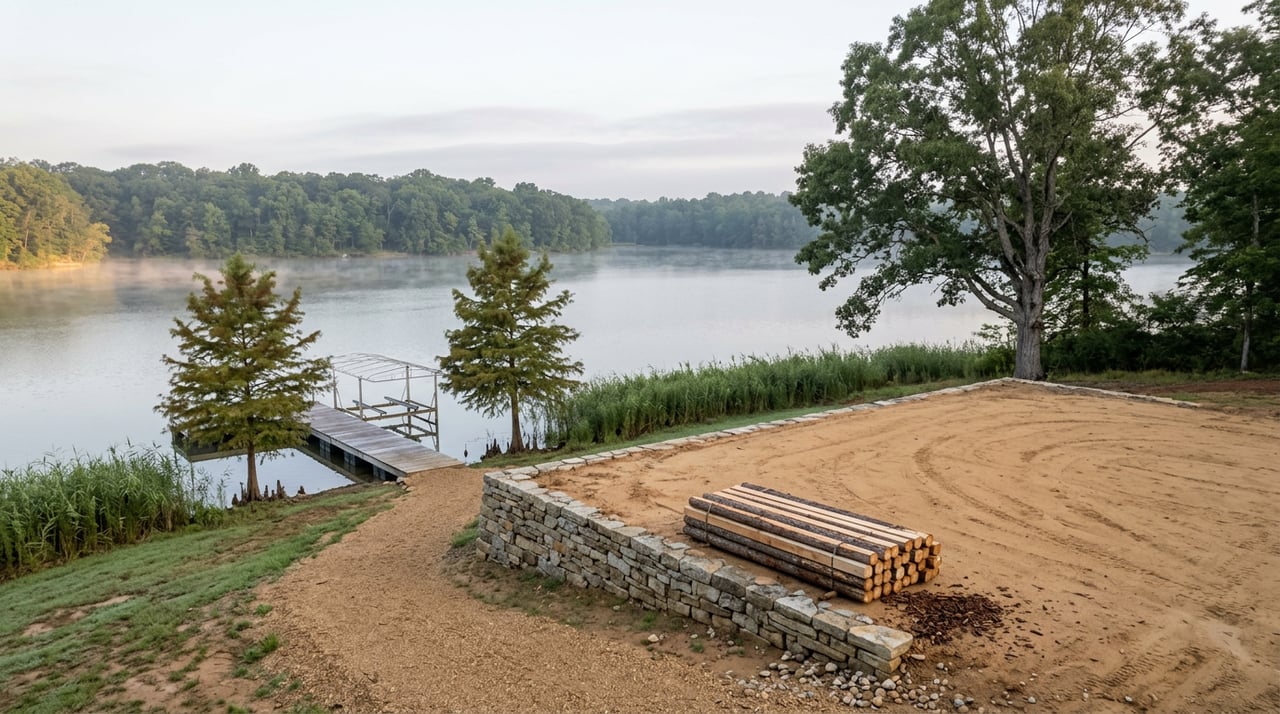
Stack a 50 to 100-plus foot no-build band against a typical narrow lakefront lot and the buildable footprint for a repair area shrinks fast. Add Lincoln County's native soil, the Cecil and Pacolet clay series, which drains at 70 to 110 minutes per inch, considerably slower than sandy soil, and drainfields have to be built larger just to function, which eats into that same shrinking footprint. Sloped lakefront terrain adds one more complication: without careful engineering, effluent can surface downslope, a failure mode local installers call daylighting.
None of these rules is a secret. What is easy to miss is that they compound on exactly the lots buyers pay the highest premium for.
Here is the part that actually catches people off guard. Lincoln County Environmental Health, which handles every septic permit in the county, does not accept applications online. Every Improvement Permit, Authorization to Construct, Repair Permit, and Existing System Approval has to be delivered in person to the department's office at 115 W. Main Street in Lincolnton.
Once an application is submitted, the county advises allowing approximately one to two months from submission to the initial site visit for an Improvement Permit or Construction Authorization, with processing time subject to weather and staffing. An Improvement Permit, once issued, confirms a lot can support a system and stays valid for five years. A Repair Permit follows the same in-person process. An Existing System Approval, the document that confirms the condition of a system already in the ground, is frequently the one requested during a real estate transaction, and it runs through the same office on the same timeline.
Set that one to two month window against a standard due diligence period, and the mismatch becomes obvious. If an inspector flags a lift station or drainfield issue that requires county sign-off before the property can close cleanly, the calendar that actually governs the fix is the county's site-visit backlog, not the closing date in the contract. A buyer who assumes a permit question can be resolved inside a two or three week due diligence window is assuming something the county's own posted guidance does not support.
This is also why North Carolina no longer relies on the perc test most out-of-state buyers expect, the old method of pouring water into a hole and timing the drain. The state replaced it with soil morphology evaluation, where an evaluator digs several test pits and examines the physical soil profile directly, because a perc test only measures what soil does on one particular day. The state's own septic rules were overhauled effective January 1, 2024, the largest revision in 34 years, changing how soil is evaluated and how systems are designed and permitted. That overhaul is now recent enough that it still surprises buyers relocating from states where the old perc-test expectation persists.
A standard home inspection does not open a septic tank or run a lift station under load. If you are under contract on a Denver-side property, ask your agent to coordinate a licensed septic contractor and request the following before your due diligence period expires, not after:
If any of these turns up a problem, you have room to act on it. A finding from a licensed septic contractor can support the same repair credit or price adjustment request as any other inspection finding, as long as it is documented in writing and presented before due diligence closes, not discovered after.
Can I renegotiate price if a septic or lift station issue turns up during inspection? Yes. A written report from a licensed septic contractor can support a request for a repair credit or price reduction the same way any other inspection finding does, provided it is documented and submitted before your due diligence period ends.
Does an Improvement Permit expire? An Improvement Permit is valid for five years and can be renewed if site conditions have not changed. For a home already built, ask whether the system operates under an Operation Permit instead, since conventional systems (Type I through IV) carry an Operation Permit that does not expire, while advanced systems (Type V or VI, including drip dispersal) require renewal every 60 months with a professional inspection.
Is this only a concern for basement homes? Lift stations are specific to basement-level plumbing that sits below the tank line, which describes a meaningful share of Denver's lakefront inventory. Homes without a basement bathroom or laundry room typically rely on gravity flow and do not carry this particular risk, though the setback and soil considerations still apply to any future repair.
A house on Lake Norman's west shore is still, first, a house on the water. But on this side of the lake, the paperwork that protects that water is also the paperwork that determines what you can and cannot do if something below the surface ever needs fixing. Knowing which permit applies, and how long the county actually takes to answer, is the difference between a contingency that protects you and one that just looks like it does.
If you are evaluating a lakefront or near-lake property in Denver and want a second set of eyes on what the septic file actually says before your due diligence period runs out, Scott Cervo brings three decades of combined construction and brokerage experience to exactly this kind of read. Request a private valuation and consultation to walk through what a specific property's file does and does not tell you.
Stay up to date on the latest real estate trends.