Cornelius Lakefront Showings This Winter Won't Show the Low Water. May Already Did.
October 22, 2026
October 22, 2026
"Lake Norman is a completely different lake during these drought conditions," Officer Scott Minderlein of the Cornelius Police Department lake patrol told Cornelius Today in June. His unit took 24 calls in early May to help boats that had run aground, mostly near islands and shoal markers. In a normal summer it gets fewer than five calls a month.
Those calls matter to anyone buying or selling lakefront in Cornelius this winter. In a normal year, January and February are when a dock's real depth shows, because Duke Energy lowers the lake every winter. This year Duke has said it does not expect to lower the lake that far. The low-water test on every Cornelius shoreline already happened in spring 2026, and the evidence from that test belongs in the transaction file. A walk to the end of the pier in February will not supply it.
Lake Norman is a working reservoir. The Lake Norman Marine Commission notes that the lake can vary by as much as 8 feet in normal operation and is generally drawn down in fall and winter. Duke publishes a monthly normal target for each step of that cycle, measured against a full pond of 100 feet, which equals 760.0 feet above sea level.
This year that cycle is on hold. The Catawba-Wateree basin has been in Stage 2 of the Low Inflow Protocol since May 1, 2026, according to the Catawba-Wateree Water Management Group. On Duke's Lake Norman page, the utility says normal seasonal drawdown targets are suspended under the basin's drought program. It does not expect to lower the lake to its typical winter elevation of 94.0 feet while Stage 2 lasts, because holding storage protects water supplies across the basin.
| Month | Duke's normal target | What 2026 has looked like |
|---|---|---|
| May | 98.5 ft | Annual low of 94.3 ft on May 22, per QC News |
| October | 98.5 ft | 98.09 ft on Duke's page at 10:51 p.m., October 19 |
| November | 97 ft | Drawdown targets suspended under Stage 2 |
| December | 96 ft | Drawdown targets suspended under Stage 2 |
| January | 96 ft | Drawdown targets suspended under Stage 2 |
| February | 94 ft | Duke does not expect to reach 94 ft while Stage 2 lasts |
The table shows the reversal. The lowest water of 2026 arrived in late spring, when the normal target is close to full. It came within a fraction of a foot of the February target, and Duke now says it does not expect to reach that February figure this winter. Duke's page also says levels will keep varying with weather, inflows and demand, and that operations may change if basin conditions improve and the restrictions ease. A buyer touring a Cornelius dock in the coming months may see more water under it than a typical winter would leave.
The spring readings came first and the shoreline impacts followed. WBTV reported the lake at 94 feet on May 18. The May average over the previous five years was roughly 98 feet, and aerial footage showed patches of dry shoreline. Four ramps at Blythe Landing had closed. In June, QC News reported that four of the landing's six ramps were still closed. Cornelius Today put levels at three to four feet below target and five to six feet below full pond. It noted that summer levels had last been in that range in 2002 and 2007.
The Cornelius businesses that work the shoreline saw it on private docks. In a June Cornelius Today survey of local businesses:
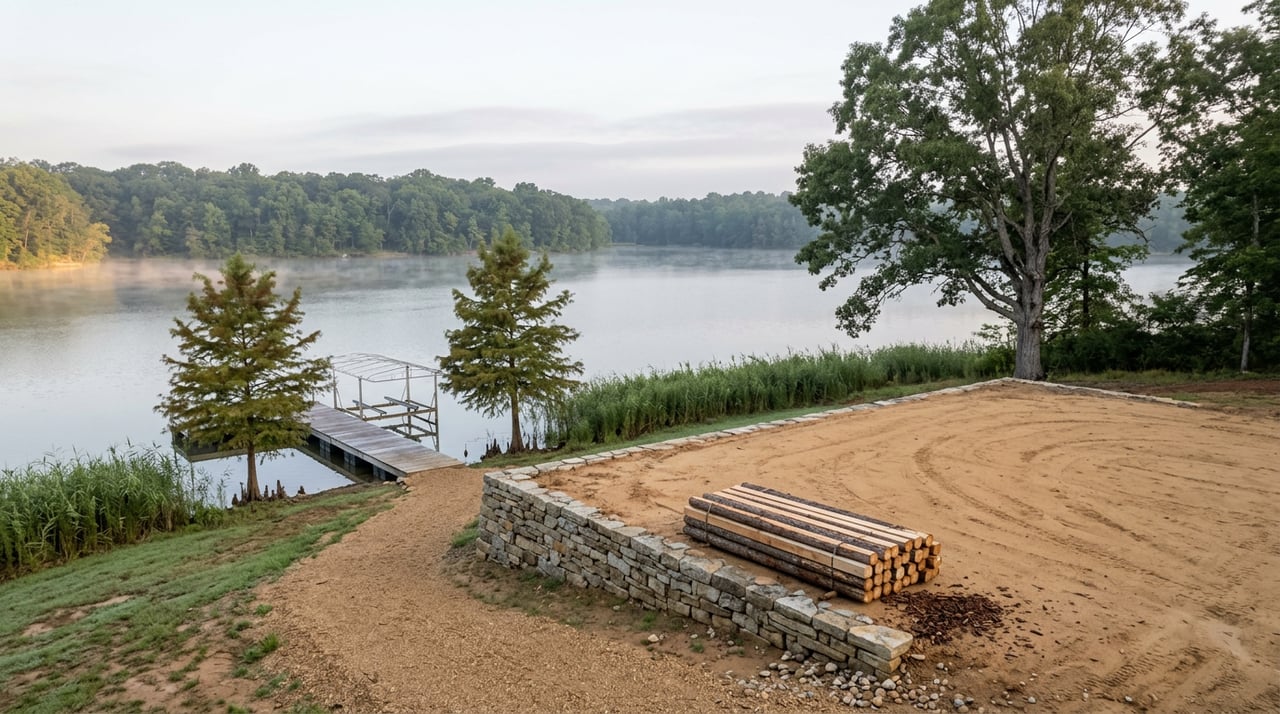
A boat that sat on dry land beside a private dock in May is the clearest depth measurement any Cornelius lot will get this year. The water came back only partway. On August 5, QC News had the lake at 96.5 feet, still about 2 feet below target. Brett Hartis, a water resources manager for Duke Energy, told Cornelius Today in August that the Catawba watershed had been trending toward drought since October 2024, after Hurricane Helene, and that groundwater was severely depleted. "Right now, any of these rain events are like pouring water over a dry sponge," he said.
A buyer who finds the water at a dock too shallow usually considers excavation next, meaning dredging a slip or access channel. Duke's Shoreline Management Guidelines govern that work. Removing soil, sand, silt or rock inside the project boundary requires written authorization from Duke Lake Services. It also requires any federal, state and local approvals those agencies call for.
Excavation is also prohibited in March, April, May and June to protect fish spawning areas. The 2026 low therefore fell inside the window when no one could dig. The same guidelines generally bar new excavation in water willow beds and inside the 50-foot offset next to shoreline classified as Environmental. The exception is work needed to keep access to a facility that was already approved. Non-maintenance projects that remove more than 2,000 cubic yards go to FERC for review.
The fees show up in a renovation budget. Duke's fee schedule, effective January 15, 2025, lists excavation application fees of $3,000 or $6,000 plus a $2,000 security deposit. The higher fee applies when FERC approval is required. Private excavation also carries a separate $500 Catawba-Wateree Habitat Enhancement fee. Applications go through Duke's online Lake Access Permit System, according to Duke's permitting FAQ. Contractors who use Duke-owned access areas for docks, dredging or stabilization work also need an Access Area Use permit, according to Duke's Permits for Shoreline Activities page.
When a dock's usefulness depends on excavation, the buyer is pricing three things: the work, the approvals, and a calendar that closes for four months every spring. That is a construction question as much as a valuation question, and in 2026 it hinges on how deep the water was in May, a measurement the showing cannot provide.
Duke's own information sheet for prospective lake buyers says the most common question Lake Services gets from buyers and agents is whether an existing dock is properly permitted. Its answer is to ask the seller for a copy of the pier permit and application. Lake Services provides records only when they are in the seller's name. If the seller never transferred the permit, they have to apply for a transfer, and that process will identify any compliance issues. If a buyer closes on a property with compliance issues, Duke will likely expect the new owner to correct them. Lake Services does not pre-approve structures. A buyer who is counting on modifying or adding a structure should require the seller to get Duke approval before closing. Those approvals are good for one year and can be transferred to the buyer.
For a Cornelius lakefront deal this winter, the file should include:
On a listing that already has this file, a buyer's questions are answered at the showing. Without it, a buyer has to price in the risk of the unknown.
The same drought restrictions apply on land. Charlotte Water's drought page still showed Mandatory Stage 2 in mid-October, with an 8% reduction from baseline as of October 16, 2026. Outdoor irrigation is limited to two assigned days a week between 6 p.m. and 6 a.m. Odd-numbered addresses water on Tuesday and Saturday, and even-numbered addresses on Wednesday and Sunday. Hand watering and drip or soaker hoses are allowed. Discretionary power washing, filling residential pools and running non-aquatic decorative water features are prohibited.
For a lakefront listing, that changes the usual prep work. Power-washing a dock, deck or facade before photography may not be permitted while Stage 2 lasts. Planting for curb appeal has to fit a two-night watering schedule or rely on drip lines. An empty pool will stay empty for the listing photos. These rules are written for Charlotte Water customers, so confirm how they apply to your own property and contract with the right professional. This post is general information, not legal, tax or financial advice.
Will Lake Norman drop to its usual winter level if Stage 2 ends? Duke says lake operations may be adjusted if basin conditions improve and the restrictions are reduced or lifted. Current levels are posted on its lake page and are also available at 800-829-5253 and through the Duke Energy Lake View app.
Who answers dock, shoreline and dredging questions on Lake Norman? The Lake Norman Marine Commission refers those questions to Duke Energy Lake Use Permitting at 800-443-5193.
Is a full lake this winter a sign the drought is over? No. Duke's own page ties the higher winter level to Stage 2 drought management, not to recovery. In August, Hartis told Cornelius Today that a return to normal would take a long time.
If you are buying or selling on the water in Cornelius this winter, Scott Cervo can help you assemble the spring 2026 dock record, permit history and construction-informed pricing before a buyer asks for them. Request a private valuation and consultation.
Stay up to date on the latest real estate trends.